Showing posts with label Just Thinking. Show all posts

Wednesday, May 18, 2022

Do You Have a Wild Child?

 "Adopt the pace of nature, her secret is patience." Ralph Emerson


Eli hugged me at church Sunday morning and with wide eyes he said, “Mrs. Kahue, Mrs. Kahue, my tadpole died! We had a funeral service for him and buried him in the backyard!"


My heart sank.  What have I done, giving this child a tadpole to kill?  


I remember my own childhood.  My mother, who immigrated from the Netherlands with my dad and my two siblings, often took me by the hand for long walks in nature.  My parents had a small business and worked seven days a week, but my mom somehow found time to go for these walks, just to look at what was out there. We walked around the gravel pit we lived by to see what kinds of fish and plants were there.  She taught me about the trees and the flowers, the seasons and the birds. 

Her hands were almost always dirty and her nails were not clean or manicured but she loved the earth.  While still living in Holland, my parents daily placed us on bikes and took long rides into the woods. I used to love these adventures, and my nickname came from the name of one of these back-roads out in the Dutch wilderness.  


Once, my dad forgot to empty his pockets of all the snakes he had collected that day. Later that night, my mom found a snake in the bed! These small ventures into the country (as well as the snake in the bed) led to aquariums full of reptiles, and later a greenhouse in the back yard to house all the flora and fauna that my parents acquired. 


Later, they immigrated to the United States and built a thriving business from their passion for plants. I followed in their footsteps, spending many hours in nature investigating the fish in the gravel pit.  I remember fishing in the canoe almost every day after school just trying to catch ‘The Big One’, that largemouth bass who lived in our gravel pit.  My friends and I built forts and rafts for hours on end.  We jumped on our bikes in the morning and didn’t come back home until right before dark.  


My heart aches for children today who don’t know what this kind of freedom is like.  


In fact, Howard Gardner, a professor of education at Harvard University, developed his influential theory of multiple intelligences in 1983. Gardner argued that the traditional notion of intelligence, based on I.Q. testing, was far too limited; he instead proposed seven types of intelligences to account for a broader range of human potential in children and adults. These included: linguistic intelligence (“word smart”); logical-mathematical intelligence (“number/reasoning smart”); spatial intelligence (“picture smart”); bodily-kinesthetic intelligence (“body smart”); musical intelligence (“music smart”); interpersonal intelligence (“people smart”); and intrapersonal intelligence (“self smart”). More recently, he added an eighth intelligence: naturalist intelligence (“nature smart”). 


“The core of the naturalist intelligence is the human ability to recognize plants, animals, and other parts of the natural environment, like clouds or rocks. The Montessori movement, along with other education approaches, has made this connection for decades. However, the impact of nature experience on early childhood development is, in terms of neuroscience, understudied. 


Professor Leslie Owen Wilson states children with a high nature IQ:

 1. Have keen sensory skills, including sight, sound, smell, taste, and touch.

2. Readily use heightened sensory skills to notice and categorize things from the natural world. 

3. Like to be outside, or like outside activities like gardening, nature walks, or field trips geared toward observing nature or natural phenomena. 

4. Easily notice patterns from their surroundings—likes, differences, similarities, anomalies. 

5. Are interested in and care about animals or plants. 

6. Notice things in the environment others often miss. 

7. Create, keep, or have collections, scrapbooks, logs, or journals about natural objects—these may include written observations, drawings, pictures and photographs, or specimens. 

8. Are very interested, from an early age, in television shows, videos, books, or objects from or about nature, science, or animals. 

9. Show heightened awareness of and concern for the environment and/or for endangered species. 

10. Easily learn characteristics, names, categorizations, and data about objects or species found in the natural world.


Do you have such a child in your family? 


Take a look at Theodore Roosevelt and his peculiar childhood.  Interestingly, his mother let him tie a snapping turtle to her washing machine!


A family fortune, beloved father, and determination to overcome childhood infirmities set young Theodore Roosevelt on course to become the 26th president of the United States. Born into one of New York City’s wealthiest clans on October 27, 1858, Roosevelt was called “as sweet and pretty a young baby as I’ve ever seen” by his maternal grandmother, although his mother thought the newborn resembled a turtle.

Although lacking in physical strength, the wisp of a boy abounded in intellectual power. Often confined to bed, the curious Teedie was tutored at home and found companionship on the bookshelves of his family library. “As he gasped for breath, Roosevelt kept going by reading avidly—especially the adventures that featured struggle and triumph against danger by larger-than-life heroes,” Dalton says. “Already his imaginative life was peopled by the Ivanhoes, Robin Hoods, Natty Bumpos and Civil War and American Revolution soldiers, all heroic male adventurers who transported him far from his sickbed.”


Roosevelt amassed a collection of animal specimens and, to the consternation of the family’s housekeepers, took professional taxidermy lessons. His menagerie included snapping turtles and a family of gray squirrels. He kept live mice in his shirt drawer and dead ones in the icebox. By age 11, Teedie had collected 1,000 items that he referred to as the “Roosevelt Museum of Natural History.”


Roosevelt fulfilled the credo of his revered father: "Get action. Do things. Be sane. Don't fritter away your time."


After becoming president in 1901, Roosevelt used his authority to protect wildlife and public lands by creating the United States Forest Service (USFS) and establishing 150 national forests, 51 federal bird reserves, 4 national game preserves, 5 national parks, and 18 national monuments by enabling the 1906 American  Antiquities Act.  During his presidency, Theodore Roosevelt protected approximately 230 million acres of public land.  


Conservation increasingly became one of Roosevelt's main concerns. After becoming president in 1901, Roosevelt used his authority to protect wildlife and public lands by creating the United States Forest Service (USFS) and establishing 150 national forests, 51 federal bird reserves, 4 national game preserves, 5 national parks, and 18 national monuments by enabling the 1906 American Antiquities Act.  During his presidency,Theodore Roosevelt protected approximately 230 million acres of public land.

Today, the legacy of Theodore Roosevelt is found across the country. There are six national park sites dedicated, in part or whole, to our conservationist president. 


I wonder how this world would look if “Teedie” had not had the freedom to tie a snapping turtle to the wash basin, or keep mice in his clothes drawer or explore nature as a child.  I wonder, if in our zeal to keep our children clean and safe, we are not stifling their neurological development?  In our drive to save the earth, are we stifling our children’s development to fall in love with creation and the Creator who made it?  


You see, I believe children need to grow up enveloped by creation in order for them to develop into their complete original design.  


They need to be exploring the woods and the grasslands and the lakes and the rivers in order for their minds to grasp the enormous brilliance of their Creator.  They need to have freedom and adventure and dirt and danger to learn how to navigate the earth that is their home.  


— And yes, a tadpole might die in the process.  


I have heard from many children who successfully released their tadpoles back into the wild where they belonged. These children spoke lovingly of their beloved little slimy friend as they let them go to explore their new home.  Many students saw their tadpole grow legs and become fully fledged frogs before their departure.  
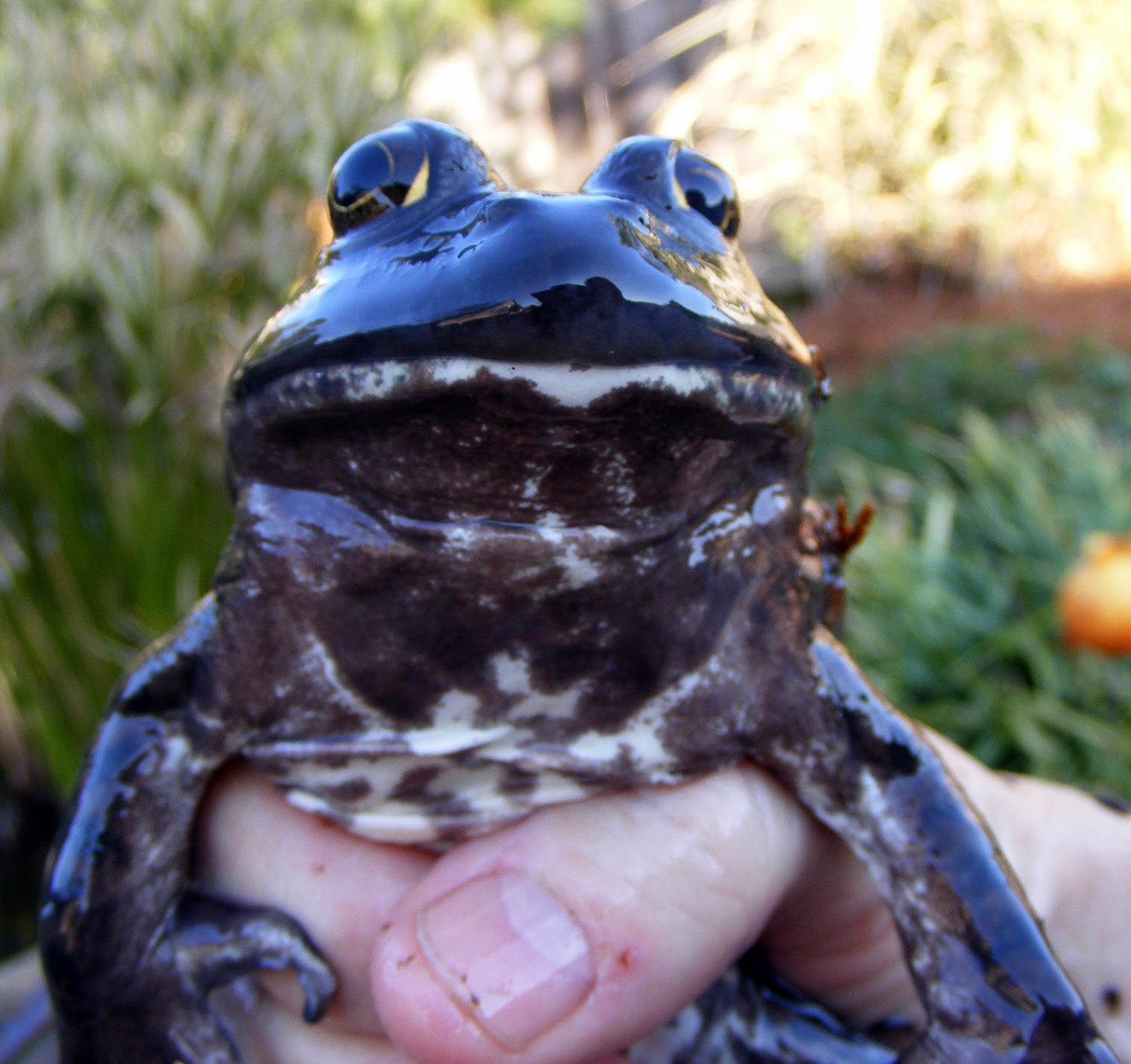
I hope these children will never be the same because of it.  


“Ah, Sovereign Lord, you have made the heavens and the earth by your great power and outstretched arm. Nothing is too hard for you.”  Jeremiah 32:17

Saturday, May 25, 2019

Thank You For Your Service

Tuesday May 21st was a sad day for us here on the farm.  Our beloved friend Mauka passed away quickly in the early morning hours. He died instantly guarding the goats in the corner of the pasture where he normally barks at predators.  On the same day Mauka passed my husband went to the funeral of a Vietnam Veteran buddy.

It was a tough day.

Too many veterans end their life due to war trauma.  If you or someone you know who is a veteran needs help please direct them to Operation Restored Warrior.  They can help.
                                                                   
Mauka's soul was beyond my ability to describe here.  Language can't quite capture the essence of this amazing animal and friend but I will try my best.  
Our journey together began when we moved to the farm back in 2008.  We started out as clueless farmers with a small herd of alpacas.  We needed a guard dog because South Carolina has lots of bad guys here.  Coyotes, foxes, raccoons, and other dogs all love to taste the delightful treats (chickens, rabbits, goats) here on our property.  

Our grandson Peter was visiting us when we headed up to North Carolina to pick out some dogs.  We came home with Mauka and his sister Lani; two of the best Great Pyrenees dogs ever created!  Poor Peter was not quite sure about riding in the car with two big white monsters right behind him! 

Mauka protected the alpacas with great care.
 
Our grandchildren loved him dearly.  Even though his size was large and somewhat overwhelming, they sensed the gentle and kind soul emanating from that huge hairy body!  Ella Bella Petronella is afraid of dogs, especially large ones, but not so with Mauka.  

Mauka attended all 13 of our Farm Labs this past week.  The students were able to love on him, brush him, and marvel at the fact that such a big dog can hang out with baby rabbits, 

tiny chicks, and baby goats, 

all together in the same pen.  

How do you say goodby to such a gentle giant and loyal companion?  My husband and I buried our dear friend Mauka in the back corner of the property.  We both cried as we remembered the wonderful times we had together for the past 12.5 years.  We thanked him for his unrelenting devotion and service to us and to our family.  

We love you Mauka.  Thank you for your service.  You will never be forgotten.  Even in death you still reach out to teach me.  As I've been reflecting on Mauka this is what I believe he would want me to know. 
  • My "to do" list is not as important as saying hello and goodbye when I greet my loved ones.  You never know if it might be the last time.  I would give anything to rewind the clock and hug him and tell him how much I love him one more time.
  • Non-verbal communication speaks volumes.  Mauka never uttered one word his entire life yet he was a transmitter of unconditional love and loyalty to all who were fortunate enough to encounter him.  
  • Don't let looks fool you.  Mauka was large and scary yet his eyes gave him away.  He was a lover of humans, other dogs, and those who needed his protection.  
  • Love your work.  Mauka loved to protect and he worked any hour of any day if his services were needed.  
  • Recognize greatness, it is all around you.  Mauka was more than a remarkable dog.  He was my friend, my protector, my helper on the farm, and loyal to the bitter end.  I didn't quite grasp the value of his greatness until he left us so suddenly.  I wonder how many other humans and animals are part of my life and I don't see their beauty or recognize their greatness shining out.  That  70's song "Don't It Always Seem To Go That You Don't Know What You've Got Till It's Gone", (Big Yellow Taxi) by Joni Mitchel makes me sad.  I was in the presence of greatness and was too busy to recognize it.  
  • Always be grateful to those who stand guard over you. They deserve honor for what they do.   
And to all the faithful ones both human and animal who helped protect us we thank you this Memorial Day!  

Sunday, October 22, 2017

Operation Restored Warrior

What an amazing weekend we had in Colorado for the Operation Restored Warrior annual reunion.  

This is Mel and I with Paul Lavelle, founder of ORW


Mel and I met with Shannon.  Shannon was recently featured on CBN. He is a former navy seal who attended ORW and now facilitates. This is Mel and Shannon with Shannon’s service dog Pig Bear. 


Our dear friend Jim 
happened to be there during the filming.  
There were about 170 veterans and their wives represented at the reunion. Mike Lindell from ‘“My Pillow” is a former attendee and spoke last night. Mike Lindell also went through the ORW program and bears the ring. 

This is Mel with David Shannahan 

of the  Mary Crowley Cancer Research Center.  https://www.marycrowley.org/

We met so many amazing veterans and new friends.

Billy Kay and Jim attended the reunion with us!!!

If you know of a veteran who needs healing and restoration please contact us or check this out.  http://operationrestoredwarrior.org/

Come and join us on Veteran's Day for "Walk it Out" .


What fun we had.  I can’t wait till next year.  :)

Thursday, October 3, 2013

Quiet PLEASE!!

I worry sometimes. 

Working in a busy school with so many little faces peering up at me is quite a challenge. The needs and concerns presented by each little developing mind can be daunting. I want to take a moment to ask you to consider the quiet child when you ponder the vast sea of educational and psychological perplexities of whom teachers and parents attempt to nurture into adulthood.

“Consider this cautionary tale, told to me by Dr. Jerry Miller, a child psychologist and the director of the Center for the Child and the Family at the University of Michigan. Dr. Miller had a patient named Ethan, whose parents brought him for treatment on four separate occasions. Each time, the parents voiced the same fears that something was wrong with their child. Each time, Dr. Miller assured them that Ethan was perfectly fine.
The reason for their initial concern was simple enough. Ethan was seven, and his four-year-old brother had beaten him up several times. Ethan didn’t fight back. His parents—both of them outgoing, take-charge types with high-powered corporate jobs and a passion for competitive golf and tennis—were OK with their younger son’s aggression, but worried that Ethan’s passivity was “going to be the story of his life.”
As Ethan grew older, his parents tried in vain to instill “fighting spirit” in him. They sent him onto the baseball diamond and the soccer field, but Ethan just wanted to go home and read. He wasn’t even competitive at school. Though very bright, he was a B student. He could have done better people, who were “always smiling, always talking to people while dragging Ethan along behind them.”
Compare their worries about Ethan to Dr. Miller’s assessment: “He was like the classic Harry Potter kid—he was always reading,” says Dr. Miller enthusiastically. “He enjoyed any form of imaginative play. He loved to build things. He had so many things he wanted to tell you about. He had more acceptance of his parents than they had of him. He didn’t define them as pathological, just as different from himself. That same kid in a different home would be a model child.”
But Ethan’s own parents never found a way to see him in that light. The last thing Dr. Miller heard was that his parents finally consulted with another psychologist who agreed to “treat” their son. And now Dr. Miller is the one who’s worried about Ethan.
“This is a clear case of an ‘iatrogenic’ problem,’ ” he says. “That’s when the treatment makes you sick.  These parents are very caring and well-meaning people. They feel that without “mindfulness and understanding, any parent can have a good fit with any kind of child, says Dr. Miller. But parents need to step back from their own preferences and see what the world looks like to their quiet children.”
Excerpt From: Cain, Susan. “Quiet.” Crown Publishers, 2013-01-29. iBooks.
This material may be protected by copyright.


Perhaps the reason why I am so concerned is because I was, and still am, that quiet child. It has taken me a long time to outgrow the shyness and it still resides deeply within.  My concern is for ones that get passed over, get picked on by the bullies or siblings, can't speak up, hang back, prefer to be alone for periods of time, and generally appear to be unproductive.  I watch these little guys when they come into my classroom as they slowly start to open up and to bloom. Some who never speak, squeal in delight at the sight of a wet slippery frog.  Some who struggle with intense separation anxiety are comforted when they can sit in a quiet corner holding a guinea pig nestled in a little blanket. Some of them lose their inhibitions as they peer into the screen of our IPad microscope and watch in delight as a monarch caterpillar is birthed from its egg.  The invisible connection between the child and creation is re-established and neurons are silently whirring  away!


Recently,  I heard of a workshop at a nearby botanical garden called "Build a Secret Garden". 


This idea has really got me thinking...

Some may gasp "What if there is a spider in that secret garden for goodness sakes?!"

But have we lost something in our zeal to protect?


That sacred connection between nature and a child's developing soul and mind has been severed in our modern age of protectionism and extreme business. The necessity for these overstimulated and overmanaged children to retreat  is overlooked and under appreciated by our modern over-achieving extroverted culture.

What if parents, who have introverted children, could help their child who may suffer from intense overstimulation, create a quiet corner in their own back yards?  A place just for the purpose of creating a natural retreat of sorts.  A solitary corner where this sensory overloaded child could go to decompress from the world for a time.  It could be a circle of sunflower plants that are interlocked by a web of morning glories or flowering peas. A secret place where this child can read or pretend or just escape and be alone.  A place just for them where they alone can commune with God and creation.

Do children these days have anyplace like this?

Everywhere I go I see lots of "safe" and simple plastic toys. Sterile and clean is the predominant theme. But unfortunately the healing balm of nature is decidedly absent.

I am concerned that we are not the better for it.

I worry for the hurried child, the overstimulated child, the child who lacks space to create. There is nothing like being surrounded by nature to heal and calm an overloaded brain.  Lets be attentive to those little ones who cross our path and who are so easily overlooked and forgotten.

For more information and statistics regarding the link between nature and pre-school children click here.